

Fetal smart-sync
Your complementary second line imaging tool for diagnostic certainty
smart-sync is a Doppler ultrasound (DUS) based gating device for MRI. It detects and synchronises the fetal cardiac cycle with the MR system and enables a brand new-kind image quality.
This valuable information empowers you with greater diagnostic confidence in complex congenital heart disease (CHD) thereby supporting you in pre- and postnatal management.
Fetal smart-sync in brief

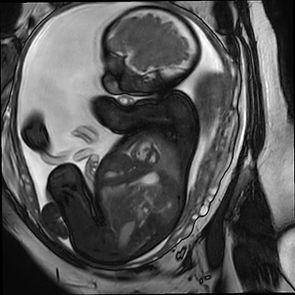
Fetal smart-sync is a Doppler ultrasound (DUS) gating technology that synchronizes the fetal cardiac cycle with the MRI acquisition, enabling clear, motion-free images of the fetal heart.
It provides pin-sharp visualization of intracardiac and extracardiac structures, enhancing diagnostic precision, especially in complex CHD cases where echocardiography alone may be insufficient.
It solves longstanding challenges in fetal cardiology and enables detailed assessment of function, morphology and hemodynamics.
Fetal cardiac MRI with smart-sync increases diagnostic confidence for clinicians in CHD, supporting better delivery planning, optimized postnatal care and clearer parental counseling.
Why should you consider fetal cardiac MRI using smart-sync?
Fetal smart-sync is assisting on all levels
772 scanned fetuses based on 27 scientific publications show 93% overall success rate of smart-sync 4


In 8 % of suspected CHD cases, echocardiography provides insufficient information for diagnosis 1
Consequence: Emergency transports, delays in optimal birth plans, increased neonatal morbidity, parental anxiety 2
smart-sync as a second line imaging tool provides clarity with 91% diagnostic accuracy – before birth, when it matters most 1
This additional diagnostic information positively affects patient management and/or parental counselling in 84% 3

How does fetal smart-sync work?
Traditional fetal MRI struggles with motion artifacts from the fetal heartbeat.
smart-sync uses Doppler ultrasound (DUS) gating to detect and synchronize the cardiac cycle automatically. Resulting in first-time crisp fetal heart imaging.


Detects fetal heartbeat via artifact-free transducer with acoustic feedback
Synchronizes with 1.5T and 3T MR systems using standard cardiac sequences
Plug-and-play setup
Outputs: From 4-chamber views over short-axis stacks to dynamic 4D flow - apply your standard cardiac MRI sequences


How does a fetal cardiac MRI session with smart-sync look like?
Insights of a Fetal Cardiac MRI scan session with smart-sync at Children's Hospital Colorado
We greatly appreciate this contribution from Children's Hospital Colorado and would like to express our special thanks to the team led by Dr. Lorna Browne and Dr. Richard Friesen (Department of Pediatric Radiology), who pioneered the integration of fetal CMR with smart-sync.


Headphones provide acoustic feedback for convenient localization of the heart
MR Safe cable ensures compatibility with 1.5T & 3.0T MR systems
Transducer detects fetal heartbeat. It is artefact-free and built with wings for easy fastening
Sensor Box communicates trigger signal wirelessly to MR scanner
What do experts say about fetal smart-sync?

"Fetal CMR serves as a powerful risk stratification tool in transposition of the great arteries. By quantifying blood flow across cardiac valves, it guides us in identifying which neonates require immediate intervention at a tertiary cardiac center versus those who can safely be delivered in a standard hospital."
- Dr. Malenka Bissell Pediatric Cardiologist University of Leeds
What are the benefits of fetal cardiac MRI with smart-sync?
The diagnosis of complex CHD (such as CoA, TGA or cardiac tumors) under difficult conditions (maternal obesity or unfavorable fetal position) with echocardiography alone can be insufficient. 1
Fetal cardiac MRI functions as a complementary imaging tool providing a high diagnostic accuracy. However, without cardiac gating, fetal movements can be challenging due to motion artifacts. 5


Parental Counselling: 68% of parents felt more comfortable with decision-making 3
Delivery Planning: Decision on site (tertiary vs. local center) and type (cesarean vs. vaginal) 3,5
Early Postnatal Care: Decision on need of prostaglandin, catheterization/intervention, surgery 3,6,7
Resource Management: Targeted use of staff, equipment and beds
How does fetal CMR with smart-sync integrate into your clinical workflow?
An accurate diagnosis has a positive impact on both pre- and postnatal management, specifically on delivery planning, parental counseling and early postnatal care, thus leading to targeted patient care 3,5,6,7

Find out more about the Integration of Prenatal Cardiovascular Magnetic Resonance Imaging in Congenital Heart Disease in this paper


-
Vollbrecht T. et al. Fetal Cardiac Cine MRI with Doppler US Gating in Complex Congenital Heart Disease. Radiology: Cardiothoracic Imaging 2023; 5(1):e220129. doi.org/10.1148/ryct.220129
-
Bonnet D. Impacts of prenatal diagnosis of congenital heart diseases on Outcomes. Transl Pediatr 2021;10(8):2241-2249. dx.doi.org/10.21037/tp-20-267
-
Salehi D. et al. JAMA Network Open. 2021;4(3):e213538. doi:10.1001/jamanetworkopen.2021.3538
-
Literature review: Recent Publications: www.northh.de/recent-publication-smart-sync. 2026
-
Desmond A. et al. Integration of Prenatal Cardiovascular Magnetic Resonance Imaging in Congenital Heart Disease. J Am Heart Assoc. 2023;12:e030640. doi: 10.1161/JAHA.123.030640
-
Vollbrecht T. et al. Fetal Cardiac MRI of Complex Interrupted Aortic Arch. Radiology 2023; 307(5):e223224. doi.org/10.1148/radiol.223224
-
Pozza A et al. Utility of Fetal Cardiac Resonance Imaging in Prenatal Clinical Practice: Current State of the Art. Diagnostics 2023, 13, 3523. doi.org/10.3390/ diagnostics13233523
Stay updated on fetal CMR with
smart-sync
If you are subscribing to this mailing list you will receive our newsletter as well as latest developments in the field